Beyond work
Rahmatyana
The Ramayana, read through the seven valleys of Attar's Conference of the Birds and the wayang stages of Java.

Pressing play loads YouTube. Closing this card pauses the music.
Sufi instrumental by Lentera Langgar · Listen on YouTubeA cultural reading in seven valleys
A Sufi reading of the Ramayana
Two journeys meet here. In one, a flock of birds crosses seven valleys to find their king. In the other, a prince walks from exile back to his city. Scroll to travel both.
Begin the journey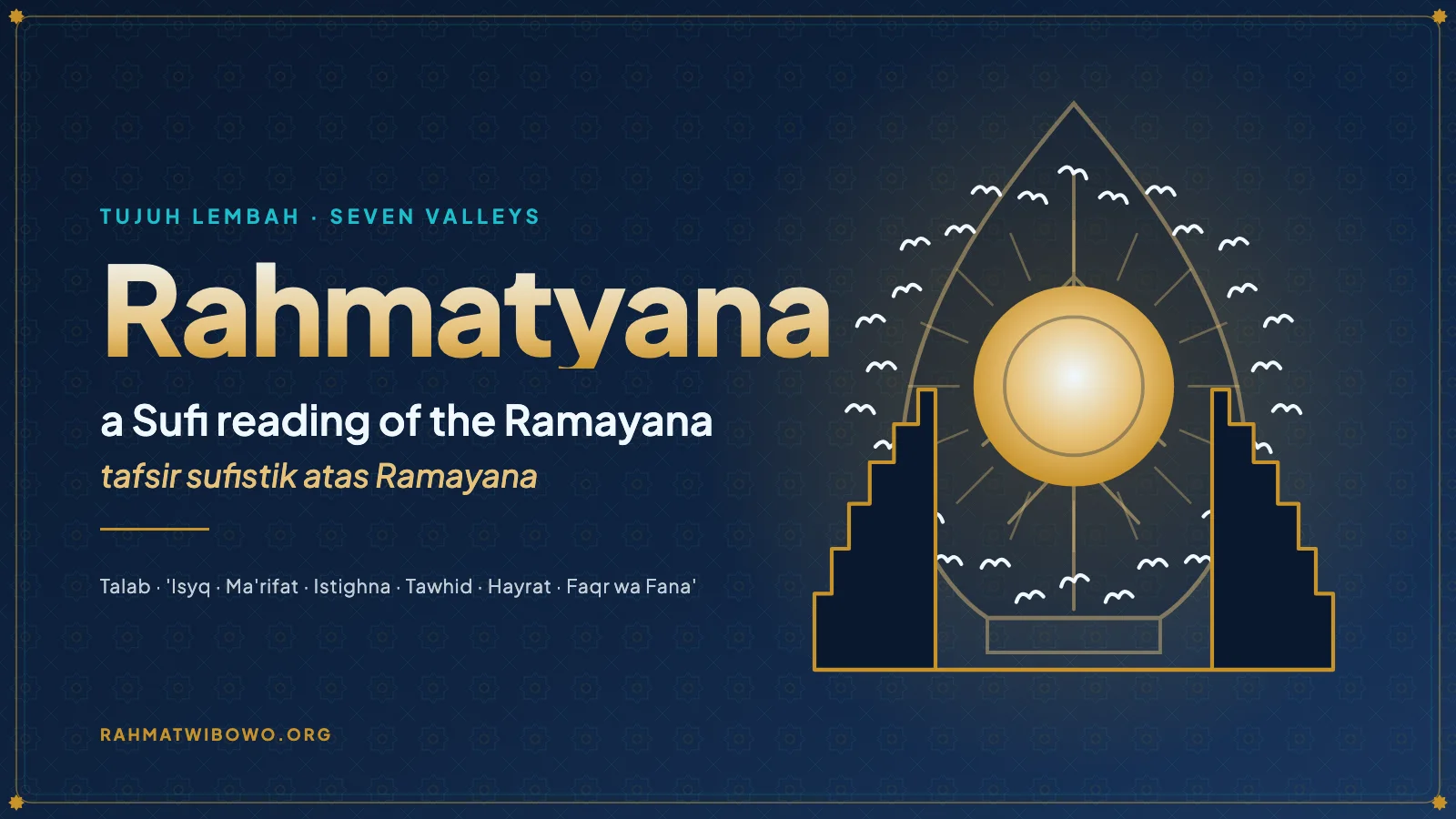
Illustration made for this page.
Prologue · Mukadimah
The reed and the hoopoe
Rumi's reed flute; Attar's hoopoe
Around 1177, in Nishapur, Farid ud-Din Attar finished Mantiq al-Tayr, The Conference of the Birds. The birds of the world gather to look for a king, the Simurgh. The hoopoe, remembered in the Qur'an as Solomon's messenger, offers to lead them, and warns that the road crosses seven valleys.
Less than a century later, Jalaluddin Rumi opened his Masnavi with a reed flute, cut from its reed bed and singing of the parting. Both images ask what the Ramayana asks: what does it take to come home? Rahmatyana pairs each of Attar’s valleys with an episode of the Ramayana as Java has told it, carved on the walls of Prambanan, sung in the Old Javanese kakawin and played behind the wayang screen.
A flute sings only because it was hollowed.
Valley 1 · Talab
Seeking
Ramayana: the exile to the Dandaka forest
Attar's first valley is the quest. Here, the hoopoe says, the traveller must put down what they own, because a seeker who keeps looking back never leaves. Many birds make their excuses before the road even starts: the nightingale cannot leave its rose, the duck cannot leave the water.
The Ramayana's quest also begins with giving something up. To keep his father's word, Rama leaves the throne of Ayodhya and goes into the forest for fourteen years with Sita and his brother Lakshmana, trading palace silk for bark cloth. Dandaka, the forest of exile, is the first place where the story has nothing to hold on to except its purpose.
Seeking begins when you stop looking back.
Valley 2 · 'Isyq
Love
Ramayana: Jatayu's devotion
In the second valley Attar describes love as a fire the traveller walks into without weighing the cost. Sufi writers kept the image. Rabi’ah al-Adawiyyah of Basra is remembered carrying a torch and a jug of water, to burn paradise and put out hell, so that God would be loved for God alone and not for reward or fear.
The Ramayana gives this valley to a bird. When Ravana carries Sita off through the sky, the old bird-king Jatayu, a friend of Rama's father, flies at him and fights until his wings are cut. He lives just long enough to tell Rama which way she was taken. His devotion asks for nothing back, which is what the Sufis mean by 'isyq.
Devotion counts no cost.
Valley 3 · Ma'rifat
Knowing
Ramayana: Anoman Duta, Hanuman the envoy
Ma'rifat is knowledge that is lived rather than memorised. In Attar's third valley every traveller takes a different path, and each knows only as far as their own strength carries them. Al-Ghazali made the same point in his account of his own search, al-Munqidh min al-Dalal: knowing the definition of drunkenness is not the same as being drunk.
In wayang this is the lakon Anoman Duta. The white monkey Hanuman crosses the sea to Alengka, finds Sita in the Argasoka garden and wins her trust with a sign: Rama's ring. Sita recognises the messenger not by his strength but by what he carries, and Hanuman knows that his task is to carry it faithfully, not to win the war alone.
To know is to recognise the sign.
Valley 4 · Istighna
Detachment
Ramayana: Bharata and the sandals
Istighna is the valley of needing nothing. Attar describes it as a place where the greatest prizes of the world shrink to almost nothing in the traveller’s eyes. Detachment here is not coldness. It is the freedom of a hand that no longer clutches.
The Ramayana's picture of it is a pair of sandals. Bharata, offered the throne his mother schemed to win for him, goes into the forest to bring Rama back. When Rama will not break his word, Bharata asks for his sandals, sets them on the throne of Ayodhya and governs in their name until his brother returns. Later in the Kakawin Ramayana, Rama teaches Wibisana, the new king of Alengka, the Asta Brata, the eight virtues of a just ruler; Bharata's regency reads like a rehearsal of them.
Power is entrusted, not owned.
Valley 5 · Tawhid
Unity
Ramayana: Rama Tambak, the causeway to Alengka
In the fifth valley, Attar writes, the many become one: whatever the traveller looks at, they see the One. Tawhid, the oneness of God, is the centre of Islamic faith, and the Sufis also read it as a way of seeing, in which the world is no longer a crowd of separate things.
In wayang this valley is the lakon Rama Tambak. Rama’s army of wanara, monkeys and bears, carries stones to the shore and builds a causeway to Alengka, the Setu Bandha of the Sanskrit epic. No single stone crosses the sea; the bridge does. Java has its own phrase for it, Bhinneka Tunggal Ika, from Mpu Tantular’s fourteenth-century Kakawin Sutasoma and now on the national emblem: different, yet one.
No single stone crosses the sea.
Valley 6 · Hayrat
Wonder
Ramayana: Sinta Obong, the ordeal by fire
The sixth valley is bewilderment. After unity, Attar says, the traveller is lost in amazement and no longer knows whether they are or are not. Hayrat is not the confusion of knowing too little. It is the astonishment of seeing too much light.
Wayang stages it as Sinta Obong. After the war, Sita steps into a fire to answer doubts about her faithfulness, and the fire gives her back unharmed. Audiences have questioned this scene for generations: why should the faithful one be tested at all? It leaves them where Attar’s travellers stand, amazed at what the fire did not burn and unsettled by why it was lit.
Wonder lives where explanation stops.
Valley 7 · Faqr wa Fana'
Poverty and dissolution
Ramayana: the return to Ayodhya
Of all the birds that set out, only thirty reach the Simurgh's court. There they find no king on a throne, only a presence like a mirror, in which they see themselves. The poem turns on a Persian pun: si murgh means thirty birds. Faqr is the poverty of owning nothing; fana' is the self fading away, so that what remains, baqa', is what was there all along.
The Ramayana closes with a homecoming. Rama returns to Ayodhya after fourteen years and is crowned, but the traveller who comes home is not the one who left. On a wayang night the dalang ends the performance by planting the gunungan, the tree of life that opened the play, back in the centre of the screen. The story returns to where it began, and the audience goes home changed.
Thirty birds looked for a king and found a mirror.
Epilogue · Rahmatan lil 'Alamin
Mercy for all the worlds
Al-Anbiya' 21:107
The Qur'an describes the Prophet's mission as a mercy for all the worlds, rahmatan lil 'alamin (Al-Anbiya' 21:107). InfraLoka holds the same phrase as its mission, and it gives this page its name: Rahmatyana joins rahmah, mercy, with ayana, journey, the same ayana that ends the word Ramayana, the journey of Rama.
Java has long kept these traditions together. The wayang screen that shows the Ramayana is the same screen that, in the stories told of the Wali Songo, carried Islamic teaching into Javanese villages. Reading Attar beside the Ramayana is not mixing creeds. It is noticing that both describe one road: leaving, loving, learning, letting go, joining, wondering and coming home.
Every valley is crossed by mercy.
About this reading
Rahmatyana is a cultural essay by Rahmat Wibowo, founder of InfraLoka. It reads two classics side by side: a twelfth-century Persian Sufi poem and the Ramayana as it lives in Javanese art.
The 3D journey and the valley illustrations were made for this page. The scene follows the seven valleys from the reed bed at the water’s edge to the dawn over Ayodhya.
A note on reading
Pairing Attar's valleys with Ramayana episodes is a literary interpretation, not a historical or doctrinal claim. The two works come from different faiths; reading them together borrows images, not beliefs. Both are summarised here in paraphrase, not quoted.
Sources
- Farid ud-Din Attar, Mantiq al-Tayr (The Conference of the Birds), trans. Afkham Darbandi and Dick Davis, Penguin Classics, 1984
- Jalaluddin Rumi, Masnavi, Book I, opening verses, trans. R. A. Nicholson
- Valmiki, Ramayana: Ayodhya, Aranya, Sundara and Yuddha Kanda
- Kakawin Ramayana (Old Javanese, c. 9th century); Stuart Robson, The Old Javanese Ramayana: A New English Translation, 2015
- Mpu Tantular, Kakawin Sutasoma (14th century), the source of Bhinneka Tunggal Ika
- Ramayana reliefs, Prambanan temple compound, Central Java (9th century)
- Al-Ghazali, al-Munqidh min al-Dalal and Ihya' Ulum al-Din
- Qur'an, An-Naml 27:20-28 (the hoopoe) and Al-Anbiya' 21:107
Let’s talk about your next transformation
Tell me what you are trying to change. I reply personally to partnership and project enquiries.